Multi-Club Ownership In Football: How Does It Work And What Are The Benefits?

Ownership in football has become a hot topic. Whether it's ethical concerns regarding the takeover of historic community football clubs by oil-rich Emirati monarchs with close links to Gulf regimes, or the creation of vast portfolios of clubs by ambitious, global-facing billionaires, the way our football clubs are owned and operated has changed enormously in the last two decades.
Understandably, supporters are keenly interested in the motivations and plans of those who have gained control.
In this article, we'll be focusing on a type of football club ownership that has become increasingly common during this recent time period: multi-club ownership (MCO). We'll explain how multi-club ownership works and what the appeal is for investors, and we'll also spend some time examining the key drawbacks and criticisms of this model.
We'll list some of the most well-known examples of multi-club portfolios and look at how football authorities are tweaking their governance structures to deal with the rise of this ownership system.
What Is Multi-Club Ownership?
The term multi-club ownership is a self-explanatory one: multi-club ownership is when more than one football club is owned by the same individual or business.
Some MCO groups are small operations, perhaps with one majority shareholding in a club and one minority stake in a separate club. However, today, there are also some huge MCO groups with ten or more different football clubs spanning the whole planet.
In recent years, this has become a more visible trend with the rise of well-known ownership groups such as City Football Group (CFG), who have used the identity and status of their flagship club Manchester City, and the financial resources of their owners, the Abu Dhabi United Group (ADUG), to buy up and rebrand clubs like New York City, Melbourne City, and Montevideo City Torque.
This idea of building and promoting a sporting brand is crucial to the application of the MCO model for many owners across the world. But whatever the size or overall strategy of the ownership entity, the principle is the same: multiple football clubs operating separately, with their own domestic and continental ambitions, but funded by the same investment arm.
How Does Multi-Club Ownership Work?
There are a number of different ways to operate a multi-club ownership group. Ultimately, there's a huge amount of variety when it comes to MCOs, and each ownership group will have their own core strategies and reasons for acquiring multiple clubs.
For some owners, there is a clear hierarchy of clubs, with one club that is obviously at the top of the pyramid (eg. Manchester City for CFG or RB Leipzig for Red Bull) and a larger group of feeder clubs that are ultimately designed to serve that bigger club.
In this case, the funding Manchester City receives from its owners will be far larger than that of many of the other teams under the same umbrella.
However, funding can be distributed however the ownership group sees fit within an MCO group. One club within a multi-club operation might have a local majority owner and only have a 20% stake controlled by the larger MCO group, and this will impact the level of influence that group can have.
In other cases, there might be an outright 100% owner who essentially has the power to rebrand and restructure the club (eg. with Melbourne City and CFG).
In recent years, various other innovative ways of structuring an MCO operation have emerged; for instance, the Right To Dream programme has forged a completely unique path by developing a multi-club, multi-academy group that started as a football academy in Ghana and now owns majority shares in Danish outfit Nordsjælland FC and new MLS franchise San Diego FC.
Elsewhere, Brighton owner Tony Bloom has benefited from having small stakes in other European clubs and using these multiple shareholdings as a way to share data and resources and allow involved clubs to punch above their weight.
What Are The Benefits Of Multi-Club Ownership?
Today, 50% of teams in the English Premier League are part of a multi club ownership operation. This statistic shows that there must be some clear benefits to teaming up with other clubs across the footballing world under a broader umbrella.
Obviously, the funding available for clubs that align themselves with extremely wealthy ownership groups like CFG is a clear advantage, with sides like Palermo benefiting from CFG cash in leagues where most clubs don't have comparably powerful investors.
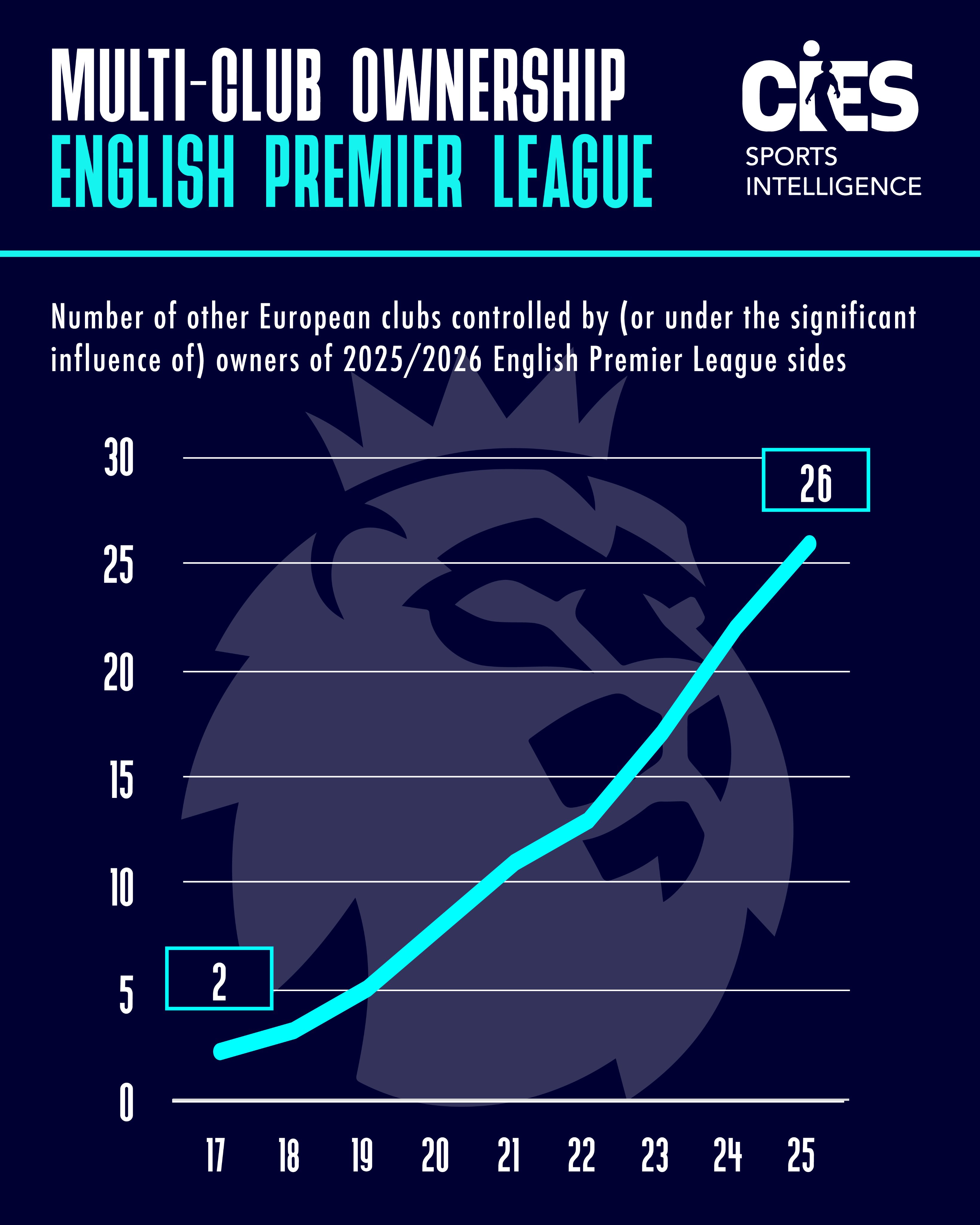
Source: CIES Sports Intelligence
That being said, perhaps the biggest advantage of being part of a MCO operation is the sharing of resources, data and information across different clubs. As long as clubs within an MCO group aren't competing in the same European competition as each other (more on this shortly), there's nothing to stop them sharing resources and ideas.
Whether its the creation of player pathways (with feeder clubs like Red Bull Salzburg able to help develop young players to be sold onto RB Leipzig, for example), to data-driven scouting and recruitment networks, multi-club ownership groups tend to use a shared group-wide philosophy to help nurture talent and progress them between systems (both for players and coaches).
MCOs can also create outposts all over the world, boosting scouting networks and gaining better insight into the football landscape of different regions in Europe, South America, Africa, or Asia.
When it comes to development, multi-club groups can also benefit from the loan system, with Premier League clubs able to loan players out easily to other clubs within their MCO umbrella, and if there is a shared style of play or coaching philosophy, that will only aid their pathway to the first team at their paraent club.
Another key factor is economies of scale, with shared services between clubs often making things more financially efficient for MCO clubs across the board.
It's important to note that often these ownership network extend far beyond football, with Red Bull (one of the world's largest multi-club entities) controlling over 15 teams in 11 different sports, including football teams like RB Leipzig, Red Bull Salzburg and New York Red Bulls, as well as Red Bull Racing in Formula One, and Red Bull KTM Factory Racing in MotoGP (they've also got minority stakes in European clubs like Leeds United).
What Are The Problems With Multi-Club Ownership?
Understandably, the clear advantages outlined above lead some people to be skeptical about the sporting integrity of MCOs. A club being able to loan out a young player or sign a promising player for a bargain price simply because they operate under the same ownership structure can be bad for competition and creates problems within a free, open transfer market.
Because of these risks, the Premier League has clear rules about transfers between 'associated parties' (ie. clubs within the same ownership group), with the EPL needing to assessing each such transfer first to confirm that it represents 'fair market value'.
If I could bin one thing from modern football, it would be multi-club ownership.
— HLTCO (@HLTCO) July 30, 2025
I hate everything it represents, the stockpiling of players, one club amongst that group being the top dog, the deals between them.
Own one club, strive to make them a success and leave it there.
Another problem with MCO groups is the vast gulf in resources and status that often exists between top clubs (like Manchester City) and clubs lower down the pecking order within a group (like New York City or Mumbai City, for example).
As The Athletic's Matt Slater explains, "We have seen over the last five, ten years, several examples of clubs that have been added to multi-club groups that frankly feel like they have been colonised, they have become feeder clubs."
Most supporters would baulk at the idea of their club being treated as a feeder club to a richer, more powerful team, but that has become the reality for many historic football clubs all over the world, and this doesn't just impact those fans directly, but the region they're within as a whole.
It's therefore no suprise that fans of at clubs like Palermo have come out and protested against being controlled by CFG, with many supporters feeling like a part of their local team's identity has been stripped away.
How Has The Rise In Multi Club Ownership Impacted Football Governance?
The growing presence of MCOs in global football has been a real test for governing bodies around the world. In Europe, the continental authority UEFA has strict guidelines stating that "no individual or legal entity may have 'control or decisive influence' over more than one club" competing in their European competitions (the Champions League, the Europa League and the Europa Conference League).
These rules have already impacted a number of clubs, with Brighton owner Tony Bloom forced to reduce his stake in Belgian side Union Saint-Gilloise to a minority shareholding after both clubs qualified for Europe in the same season.
More recently, just weeks after Crystal Palace won a historic first FA Cup trophy, the south London club was faced with potential expulsion from the Europa League (the competition they qualified for by winning the FA Cup) due to them being under the same MCO group as fellow Europa League competitors Lyon.
Eventually, the threat was staved off after shareholder John Textor, the owner of Lyon, sold his 42.9% share in the club to US billionaire Woody Johnson. Pending approval, this should satisfy UEFA and allow Palace to compete in Europe next season.
According to The Guardian, one UEFA insider said that this situation was a real test to see "if our MCO rules stand up to scrutiny as, one way or another, it looks like we’re going to CAS (the court of arbitration for sport)."
It's a test UEFA appear to have passed, and rules regarding multi-club ownership (MCO) have been upheld in other areas of the global game, with CAS backing FIFA's decision to expel the Mexican club León from the Club World Cup because they are part of the same ownership group as another qualifier, Pachuca.
However, UEFA president Aleksander Ceferin has conceded that the authorities may need to rethink their policies given the ongoing growth of multi-club ownership in the sport, with The Guardian reporting that "there is some acknowledgment at Uefa that elements of its MCO rules are not fit for purpose". Exactly what form these revisions may take is unclear at the moment.
Want to find out more about multi-club ownership in football? Check out our in-depth guide to the City Football Group (CFG), the largest MCO in world football.
Related Articles

What Is The City Football Group? (And Which Clubs Do They Own?)
