Roberto De Zerbi Tactics Explained
A number of seismic shifts occurred throughout the 2025/26 Premier League season.
At the top of the league, Mikel Arteta's Arsenal became increasingly maligned for their controlled, cautious, and physical style of play, while the ever-meticulous Pep Guardiola finally decided to let the shackles off and allow flair players like Rayan Cherki to express themselves more.
Unfancied sides like Brentford pushed hard for Europe, and down the bottom of the league, we saw the most competitive relegation battle there's been in years.
Perhaps the biggest shock of all was that deep in the midst of that basement battle was one of the country's richest and most decorated teams: Tottenham Hotspur, the club with the new £1 billion stadium, the sixth most valuable squad in the league, and the £136.8m annual wage bill.
The man brought in to save them? Ex-Brighton, Marseille, and Sassuolo head coach Roberto De Zerbi, a coach who combines a passionate, heart-on-the-sleeve character with genuine tactical innovation.
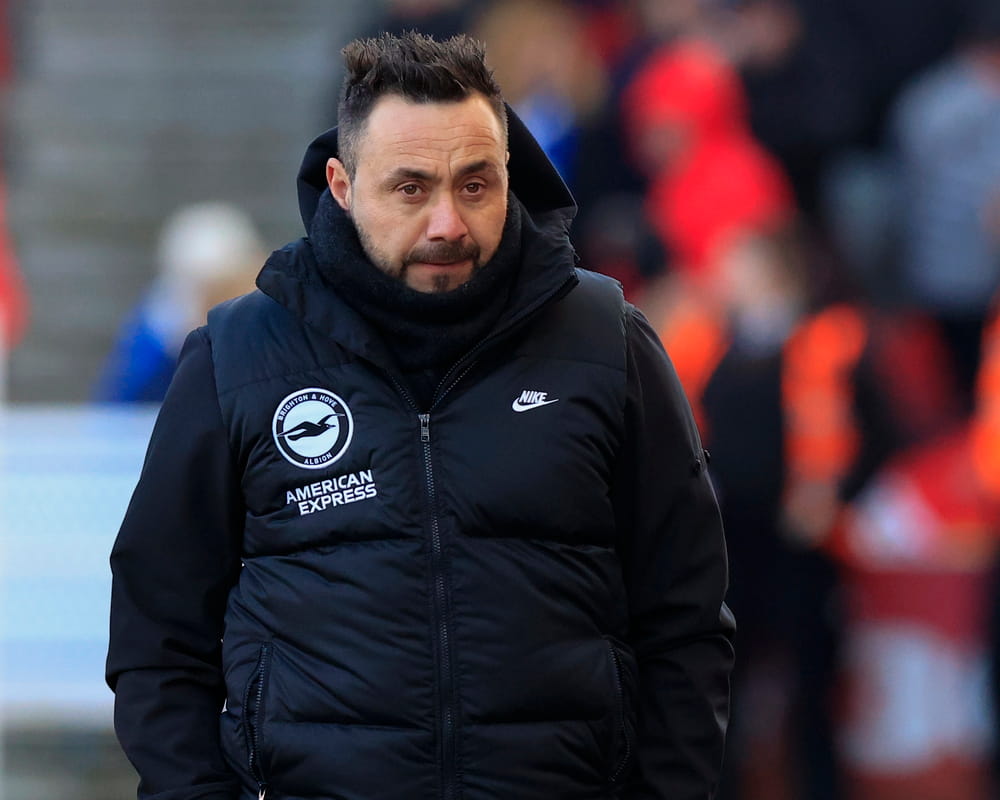
In recent seasons, he's become widely respected across Europe for his methods and results. But what style of play does he typically implement, and is it likely to be a long-term success at Spurs?
De Zerbi's Career So Far: A Brief Recap
When Brighton & Hove Albion replaced Graham Potter with Roberto De Zerbi in September 2022, he was an unknown quantity for most English fans.
After a bit of investigating, Seagulls supporters became optimistic: despite mixed spells at lower-level Italian clubs like Palermo and Benevento, De Zerbi had developed a strong reputation back in Italy.
He first made a serious mark at Sassuolo, mounting successive challenges for European football despite having a tiny budget in comparison with other Serie A competitors.
He was praised for the brand of possession-based football he implemented, and the impressive list of players he developed (which the club then sold on), which included Manuel Locatelli, Jeremie Boga, and Gianluca Scamacca.
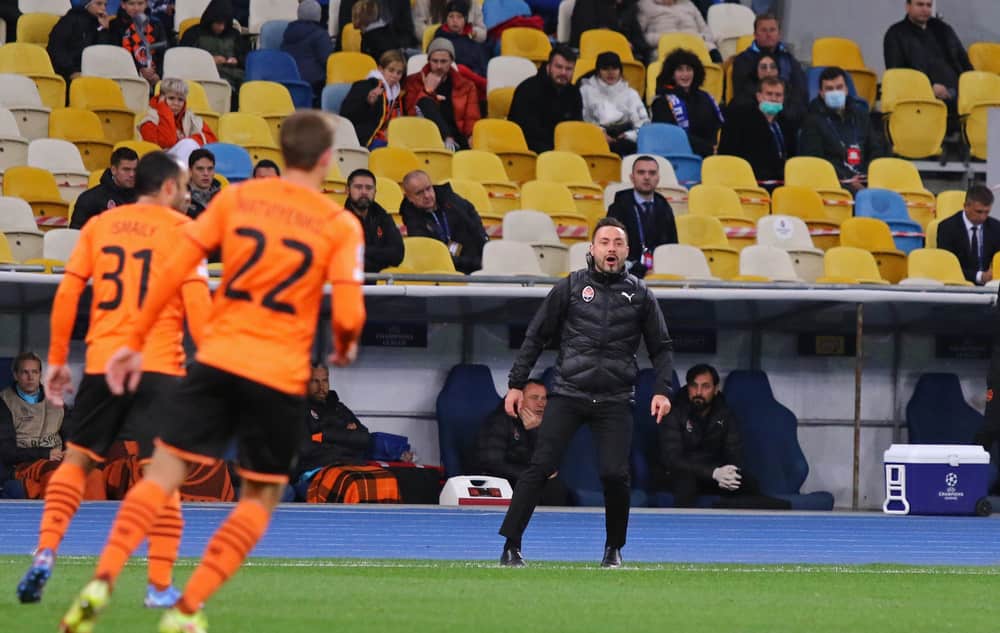
After three broadly successful seasons, De Zerbi moved to Ukrainian giants Shakhtar Donetsk in 2021.
However, he was unable to complete his first season due to the Russian invasion of Ukraine in the spring of 2022, cutting short a reign that had shown real promise: De Zerbi became the first Italian to win the Ukrainian Super Cup, and it was here that his unique and now-famous press-baiting strategy was properly refined (although it had been in development for a while by this point).
At Brighton, De Zerbi brought this revolutionary style of play to the Premier League, helping him guide the south coast club to European qualification for the first time in their history, and becoming one of the club's most beloved coaches of the modern era.
They topped their Europa League group in 2023/24, before being knocked out in the Round of 16 by Roma. The Italian boss ultimately left that summer due to clashes with the club's board.
He swiftly joined Marseille and sparked a massive improvement in results that saw them finish second in Ligue 1, qualifying for the Champions League.
De Zerbi left the club in February 2026 after Champions League elimination, with league performances also underwhelming.
His time at Marseille was full of additional controversy due to his rehabilitation of former Manchester United striker Mason Greenwood, who was iced out of the England set-up and the Premier League after being convicted of rape and assault.
This history led many fans to protest against the decision to bring De Zerbi to Spurs in March 2026, on a five-year contract with no relegation clause; however, a recent apology from the ex-Marseille manager appears to have mended some of the damage.
Roberto De Zerbi Tactics Explained
Roberto De Zerbi's start to life at the Tottenham Hotspur Stadium has been defined by an uncharacteristically pragmatic approach.
Understanding the dire form and confidence levels of his players following 16 winless Premier League games, the Spurs boss decided to first simplify his complex tactical system, stripping back certain elements and instead focusing on improving team spirit and fight amongst the squad.
One thing that has remained consistent across De Zerbi's career is a preference for certain shapes.
Most often, he's used a 4-2-3-1 formation, with a double pivot in midfield essential for progressing the ball centrally.
This was the formation he favoured in Serie A and the Premier League, although at Marseille, De Zerbi was also known to employ a 3-4-3, using wing-backs to provide more attacking width.
Throughout his career, De Zerbi's philosophy has focused on dominating the ball, using passing sequences to control games and rarely playing the ball long.
He doesn't particularly like crosses into the box, with his sides far more likely to try to generate cut-backs in the final third, or play well-timed through-balls into these dangerous areas of the pitch.
Perhaps the most distinctive element of Roberto De Zerbi's playing style is his use of press-baiting tactics, which typically revolve around two ball-playing centre-backs.
These players — at Brighton it would often be Lewis Dunk or Levi Colwill — will start off most moves, patiently recycling the ball, often killing it dead by standing on it with their studs, before delivering sharp, precise passes into central midfield areas.
Midfielders will then further progress the ball using patterns of fast-paced passing triangles, ultimately advancing into the final third.
The purpose of this tactic is to lure the opposition into pressing your back line, before quickly moving the ball around them through the centre of the pitch, to cut midfielders and attackers out of the game and create space and ultimately overloads in important areas of the pitch.
The Strengths of De Zerbi's Style of Play
De Zerbi's style of possession-based play is super patient, and at times slightly odd to watch; but when this unique game of cat and mouse clicks, it can be absolutely devastating to behold.
It's a high-risk, high-reward strategy, the primary reward being the creation of space, and the attacking momentum needed to exploit it. Defending against De Zerbi's teams when they're enacting his plan to perfection can feel like fighting against the tides.
Soon after the Italian's arrival in the Premier League, hugely influential Manchester City head coach Pep Guardiola told the media that Brighton "propose a type of game we're not used to," adding "his impact in England will be massive." Praise indeed.
According to the Guardian's Jonathan Liew, the idea of the "possession tightrope" that De Zerbi employs (meaning the patient recycling of the ball in build-up between goalkeeper and centre-backs) is "to provoke opponents into overstretching, committing one too many to the press, at which point Brighton neatly play their way out… and wreak havoc in the open spaces."
Luring opponents into a false sense of security particularly paid dividends against big clubs, with De Zerbi's Seagulls beating Liverpool, Chelsea, Arsenal and Manchester United during his reign, as the Italian racked up a win rate of 52.2% (better than any other Brighton manager).
Another metric in which his side excelled was possession; in his first year at the Amex, only Manchester City recorded a higher average possession rate than Brighton's 62.1%, and the league champions were also the only team to have more open-play sequences of nine-plus passes than De Zerbi's side, another indicator of the type of football they played.
There's no denying the broader influence this system has had, even though De Zerbi has only been implementing it at the top level for a few years.
At Manchester United, Michael Carrick has adopted certain similar principles in terms of ball progression, while there were also some parallels in the style that sacked Chelsea boss Liam Rosenior — who was at the helm of the chaotic West London club for just 107 days — tried to implement.
However, the failings of Rosenior, coupled with the difficulties De Zerbi has faced at times across his career, highlight how his tactical plan isn't always foolproof.
The Weaknesses of De Zerbi's Style of Play
Roberto De Zerbi's style of play is extremely complex and difficult to implement. Speaking after his departure, Seagulls captain Lewis Dunk admitted that the training sessions in the first couple of weeks of the Italian's stint in charge were "baffling".
He added: "Training changed dramatically, we worked on a lot of different stuff and the first couple of weeks were a really hard transition."
The system in question revolves around a goalkeeper and central defenders who are extremely confident in possession of the ball, even when in their own penalty area and facing intense pressure from the opposition.

There are plenty of good players who simply can't hack it: Chelsea goalkeeper Robert Sanchez, for example, lost his place to Jason Steele at Brighton due to the latter having better ball possession skills.
Playing this game, mistakes are bound to happen, and for a team without technically excellent players in these positions, the system can be difficult to implement.
In addition, if confidence is low, or you're in the midst of a relegation scrap, it's a hugely risky strategy to introduce (hence De Zerbi's decision to keep things simply in his early days at Spurs).
Another key thing to consider is the matter of breaking down a team that refuses to press high. It's all well and good passing your way around an intense press that you've deliberately baited, but if that press doesn't arrive, generating space and executing passing triangles becomes extremely difficult.
If De Zerbi is able to eventually turn Spurs into an elite-level Premier League side (which is ultimately the long-term goal) he's likely to face more and more opposition teams lining up in a low-block structure; it will be interesting to see whether he's able to find new ways of breaking them down.
If you'd like to dive deeper into the role that made De Zerbi a well-known figure across British football, check out our article on the rise of Brighton & Hove Albion.

Author: Fred Garratt-Stanley
Lead Content Writer
Fred Garratt-Stanley is an experienced football writer and journalist, specialising in industry insights, tactical analysis, and the culture of the game. He has contributed to publications such as NME, GQ, The Quietus, and Resident Advisor. As Lead Content Writer at Jobs In Football, he focuses on providing reliable, research-driven articles to help people navigate careers in the football industry.


Related Articles

Andoni Iraola Tactics Explained