Michael Carrick Tactics Explained
Michael Carrick’s positive early days at Manchester United came with an important caveat: it’s difficult to judge whether a quick boost in form sparked by an interim coach will ultimately lead to sustained long term improvement.
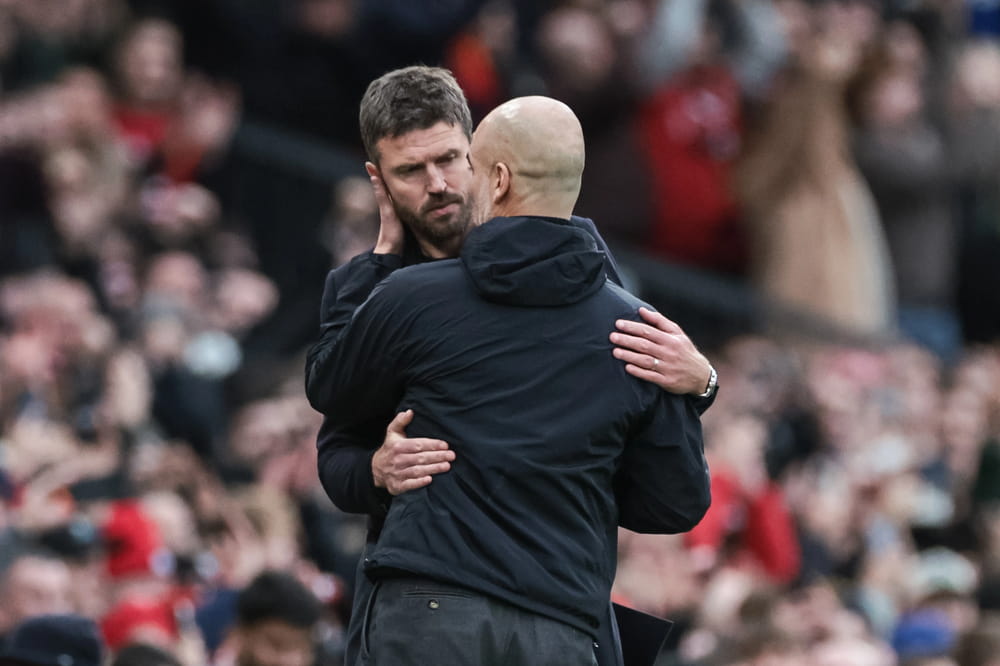
Wins against Manchester City and Arsenal understandably brought praise from various quarters; however, as supporters, pundits and reporters were quick to point out, former boss Ole Gunnar Solskjaer also performed excellently as United’s short-term interim manager, but performances famously faltered as soon as he was handed the permanent job.
In order to get a better grasp on exactly what Michael Carrick is trying to do as Manchester United manager (and whether he can be a success), in this article we’ll be explaining the key Carrick’s typical tactical set up and its key strengths and weaknesses.
We’ll look back at his coaching career so far and what we can learn from it, and we’ll delve into how he has set up his team since taking charge of Manchester United in January 2026.
Michael Carrick’s Career So Far: A Brief Recap
When Michael Carrick was handed the Manchester United job on an interim basis, he had only taken charge of around 100 senior games as a manager.
While he does have some top-flight coaching experience, having stepped in as Solskjaer's interim replacement in 2021, the vast majority of these matches came in the second tier as head coach of Middlesbrough.
Carrick started life as a coach in 2018, when he transitioned into an assistant role at Manchester United following his retirement from playing.
He worked alongside current Ipswich boss Kieran McKenna under Jose Mourinho, and following the Portuguese manager’s dismissal, Carrick stepped up to become acting manager before Solskjaer’s appointment.
A valued member of the Old Trafford infrastructure, he remained on the Norwegian’s coaching team in the following years, stepping in again as interim once Solskjaer was sacked in 2021.
Eventually, Carrick’s big break as a senior coach arrived in October 2023, when he was appointed as Middlesbrough’s head coach after the sacking of EFL stalwart Chris Wilder.
The club were in the midst of a relegation battle at the time, but Carrick quickly guided them up the table with a hugely impressive 18 wins in his first 27 matches.
This ultimately became promotion-challenging form; Boro finished 4th in the division, and Carrick was praised for the way he transformed the fortunes of key attacking players like Chuba Akpom, the scorer of 28 league goals that season.
At the end of the 2022/23 campaign, Carrick’s team ultimately suffered play-off heartbreak at the hands of Coventry City, losing 1-0 on aggregate to the East Midlands club in the semi-finals.
Boro then struggled to replicate the excellent form of Carrick’s early tenure during the next two league campaigns, finishing 8th in 2023/24 and 10th in 2024/25.
There was an impressive EFL Cup run and a serious play-off push in 2023/24, but an inability to push on the following campaign led to Carrick being sacked in the summer of 2025.
Generally, the view amongst fans was that while he had shown positive signs throughout his time in charge, the spell was a disappointment; the title charge sparked by the arrival of Rob Edwards and continued under the stewardship of his replacement Kim Hellberg have only compounded that feeling.
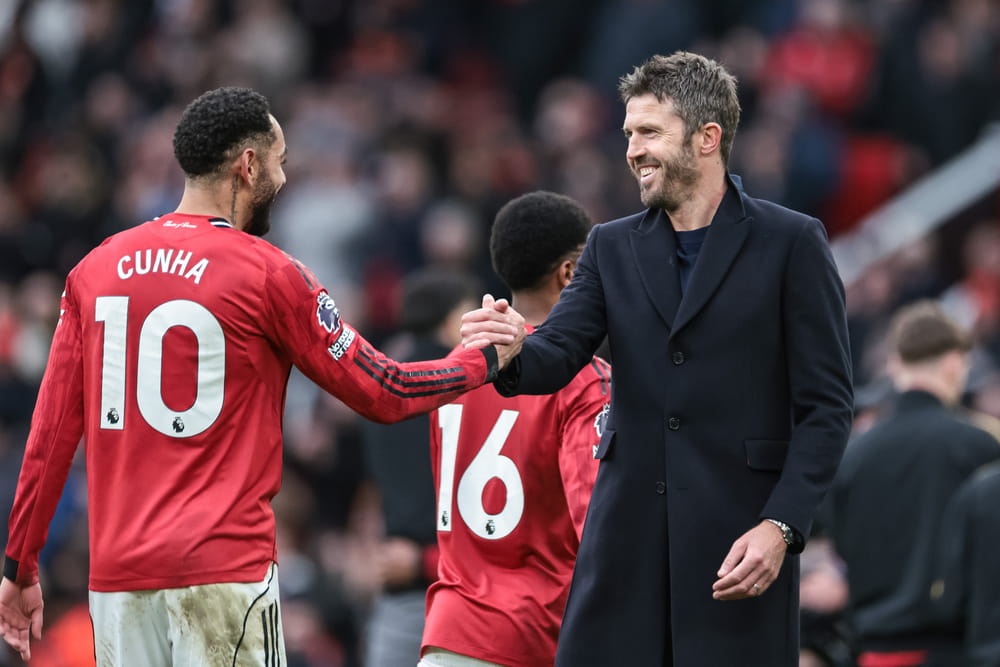
The early days of Carrick’s United tenure suggested the 44-year-old would bring some consistency and solidity to the role.
In his opening two fixtures the Englishman played an unchanged lineup, something that Amorim didn’t do in his first 36 Premier League games at United.
He’s brought a sense of simplicity, where players appear to know their job and aren’t being asked to perform overly complex tactical manoeuvres (a breath of fresh air after the Amorim reign).
The fact that Carrick has been joined in the dugout by highly experienced former England assistant Steve Holland, as well as Jonathan Woodgate and Jonny Evans, has also been viewed as a huge plus. But what style of play can fans expect from Carrick?
Michael Carrick Tactics Explained
Speaking on the Tifo Football Podcast after United’s statement 3-2 victory over league leaders Arsenal, tactics expert Jon Mackenzie insisted that “we don’t know anything” about whether Carrick’s tactics will work for the Red Devils in the long term.
However, he did identify some clear stylistic elements present in the up-and-coming coach’s game, chiefly his team’s ability to “spend long times suffering” out of possession, their threat level when counter-attacking with speed, and the similarities in terms of possession build-up with Roberto De Zerbi’s teams like Brighton & Hove Albion and Sassuolo.
“[Under Carrick, there’s been] this idea that you try and generate central progression through combinations,” he explained. “They move the ball side to side until they find a potential opening and then they try to do these tempo shifts through combinations of play.”
Wins against Arsenal and City were built on this blueprint, and while certain supporters can sometimes view this approach as a little passive, when we can look back to Carrick’s time at Middlesbrough, there’s plenty of evidence that his footballing vision is one centred on attacking, goal-scoring play.
His Boro side typically built up from the back and tended to outpass their opponents in the first two-thirds of the pitch before going up a gear in the final third and attempting to generate attacking moves at pace.
At Boro, Carrick usually opted for a 4-2-3-1 shape, playing a solid, often very effective possession-based game. But he was never strictly tied to ideas about the “right way” to play football.
He’s been reported saying he hates the word “philosophy”, and sees himself as a flexible operator, once telling reporters that “talent is a lot of different things. Sometimes that talent is to dig in, to be tough, find something extra. It’s that drive, mentality. To me, that’s still talent.”
Quotes like this suggest how the attitude, commitment level, and personality of players will often be as important to Carrick’s United as their tactical and technical skill.
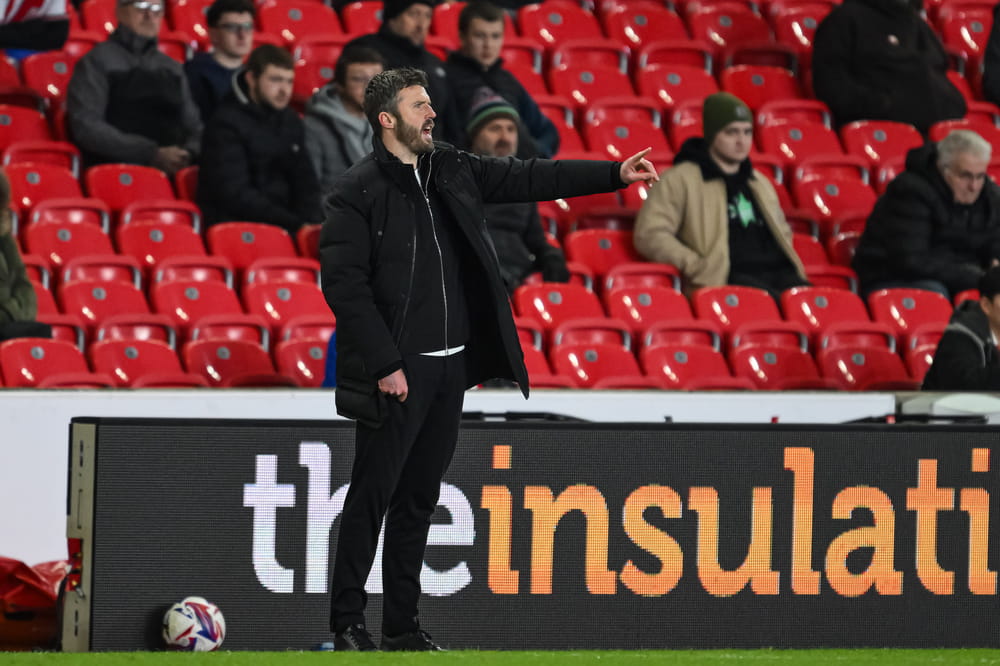
The Strengths of Michael Carrick’s Style of Play
At times, Michael Carrick’s Middlesbrough were electric in front of goal. The Teesiders scored 66 goals in his first 30 league games in charge, and their successful 2022/23 charge for the Championship play-off places hinged massively on a consistent ability to outscore the opposition.
Even in Boro’s underwhelming 2024/25 season, only three teams scored more goals than Carrick’s side: mid-table Norwich City, and the top two, Leeds and Burnley (who both accumulated 100 points).
As noted earlier, this attacking output can often rely on generating quick passing combinations in central areas.
During each of Carrick’s seasons at Middlesbrough, the club was in the Championship’s top five in terms of passes completed, and many of these were played over a short distance as the manager looked to overwhelm teams with snappy passing triangles.
His willingness to add extra bodies to midfield in order to assist with this aim (he’s regularly played with a tight three in the middle) could be seen as a major strength at Old Trafford, where under Amorim United consistently looked weak in the middle of the park, getting overrun with their poorly-balanced and tired-looking 3-4-2-1 system.
When it comes to breaking through opposition lines, United fans should take some comfort from Carrick’s record of bringing wingers infield to exploit attacking half-spaces.
He did this regularly at Boro with players like Finn Azaz looking to occupy an inverted winger role, and the combination of spatial awareness and technical ability demonstrated by Red Devils players like Amad Diallo suggest there could be some serious potential in replicating this aspect of the Boro blueprint at Old Trafford.
The Weaknesses of Michael Carrick’s Style of Play
According to Tifo’s Jon Mackenzie, at United Carrick will be judged on whether he’s able to break down opposition defences that adjust their game plan based on his early performances.
Specifically, “the lesson from Roberto De Zerbi in the Premier League was that as soon as teams stopped allowing them the spaces to play into and they sat deep, they struggled.”
When coaches play a game based on patient possession build-up and quick central combinations, they will typically lead opposition teams to adjust their approach and move into low block shapes in order to tighten things up.
It’s unclear whether Carrick has the ability to switch things up and still create chances when this happens.
The attacking quality Carrick has at his disposal means that in the short-medium term, it’s possible for him to play this way and rely on the fact that his forwards will finish their chances when they arrive.
But if opposition teams start to favour low blocks, and that shift causes those opportunities to dry up, he could start hitting obstacles.
One thing in Carrick’s favour here is his adaptability, his valuing of physicality and toughness in players, and his open-minded approach to playing style.
However, his limited amount of experience at the top level means we have little proof he will be capable of leaping over hurdles and adjusting things tactically if forms starts dipping and momentum starts to wane.
Regardless of the improvements Carrick is able to make at Old Trafford, it still seems highly unlikely that Manchester United will be challenging towards the top of the Premier League any time soon.
However, one man whose tactical blueprint and driven persona have allowed him to do exactly that is Arsenal boss Mikel Arteta. To get some insight into how he has masterminded the Gunners’ recent rise, read our guide to Arteta’s tactics explained.

Author: Fred Garratt-Stanley
Lead Content Writer
Fred Garratt-Stanley is an experienced football writer and journalist, specialising in industry insights, tactical analysis, and the culture of the game. He has contributed to publications such as NME, GQ, The Quietus, and Resident Advisor. As Lead Content Writer at Jobs In Football, he focuses on providing reliable, research-driven articles to help people navigate careers in the football industry.


