Why Executive Coaching And Mentorship Set The Best Leadership Courses Apart
Author: Dr Daniel Parnell, CEO of the Association of Sporting Directors
The sporting director's job is one of the most exposed in football. You answer to owners, align a head coach, a recruitment department and an academy, negotiate with agents and face the media. You do it on short timelines, with little margin for error and often with nobody in the building doing the same job.
That is one reason more people in technical leadership roles are turning to professional development and education. There are more sporting director courses than ever: university master's degrees, governing-body certificates and short online diplomas. Most cover similar ground, such as strategy, recruitment, finance, governance and negotiation.
So the curriculum is rarely what separates a good leadership course from a great one. The real thing we believe in is whether the course changes how you lead on a Monday morning. On that question, the evidence points clearly to two things: executive coaching and mentorship.
The gap between knowing and doing
Leadership programmes have a well-known weakness. People leave a seminar inspired, return to a full inbox, and slip back into old habits. Psychologists call this the "transfer of training" problem. Knowledge gained in a classroom does not automatically become behaviour at work. But everyone feels like it was positive!
The case for executive coaching
One of the most cited studies on this comes from a public agency in the United States. Olivero, Bane and Kopelman (1997) put 31 managers through a conventional management training programme, followed by eight weeks of one-to-one executive coaching. Training alone increased productivity by 22.4%. Adding coaching, built around goal setting, collaborative problem solving, practice and feedback, took the increase to 88%.

Figure 1. The same training, with and without follow-up coaching. Source: Olivero, Bane & Kopelman (1997).
It is a single, small study, and the precise numbers should not be over-sold. But the direction matches what later and larger research has found: content is important, however coaching can take progress and impact to another level.
For a sporting director, the outcomes that coaching moves the impact of learning most, such as self-regulation, goal attainment and skills, are exactly the ones the role demands. Good coaching often begins with a validated psychometric profile, such as the Hogan assessments. These give leaders an evidence-based picture of their strengths and of how they are likely to behave under pressure, which is when blind spots are considered important to us.
The case for mentorship
Mentoring does something different. A coach helps you understand yourself; a mentor helps you understand the world you are trying to operate in. A mentor has walked the path before and can share judgement, context and contacts that no textbook holds.
The research here is broad and consistent. Evidence is generally supportive of the benefits associated with mentoring, across both objective outcomes such as pay and subjective ones such as career satisfaction. A larger piece of research by Eby and colleagues (2008) reviewed 112 studies and found mentoring linked to a wide range of positive outcomes.
Honesty is key for us. Those studies found the individual effects to be small, and much of the evidence is correlational. The fair reading or analysis is that mentoring is a consistent, low-cost advantage that compounds over a career. It works best when it is structured, sustained and well matched, rather than left to chance.
Why this is important for a career in football
Our research on the sporting director role helps explain why these two elements carry particular weight in our industry.
• The role is ambiguous.
• Careers run on networks.
• It can be lonely.
A simple framework: Learn, Reflect, Navigate, Apply
One way to judge any leadership course is to ask which parts of the development cycle it actually covers. Most courses deliver strong content, and many include an applied project. Far fewer support the two stages in between, where knowledge becomes changed behaviour.
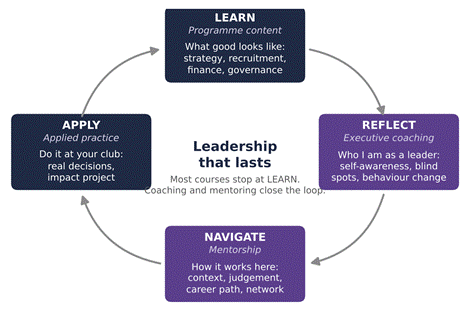
Figure 2. The Learn–Reflect–Navigate–Apply cycle. Coaching and mentoring are the two stages most programmes leave out.
Coaching and mentoring are often confused, but they do different jobs. The table below sets out how they complement each other.
|
|
Executive coaching |
Mentorship |
|
Core question |
Who am I as a leader, and how do I need to change? |
How does this world really work, and how do I progress in it? |
|
Who leads it |
A trained coach, often outside football |
An experienced industry leader who has done the job |
|
Focus |
Self-awareness, behaviour, decision-making, resilience |
Judgement, context, career strategy, networks |
|
Typical tools |
Psychometrics (e.g. Hogan), goal setting, structured reflection |
Confidential conversations, shared experience, introductions |
|
What it adds to a course |
Turns learning into changed behaviour |
Turns learning into career progress |
What to look for when choosing a leadership course
If you are weighing up programmes, look past the module list and ask the provider five questions.
1. Is one-to-one executive coaching included, or is it an optional extra? Look for confidential sessions spread across the programme, not a simple taster.
2. Is coaching built on a recognised assessment? A validated psychometric tool gives the coaching a factual starting point.
3. Will I be matched with a named mentor, and for how long? A structured, year-long pairing with someone senior in the game is very different from occasional guest speakers.
4. Who leads the teaching? Serving decision-makers bring current, practical insight alongside academic rigour.
5. How big is the cohort? Smaller groups mean more direct access to faculty and mentors, and a closer peer network afterwards.
How the AltSD MBA builds it in
The Association of Sporting Directors designed the Alt Sporting Director MBA (AltSD MBA) around these principles. Coaching and mentoring are part of the core structure of the 12-month programme, alongside the taught content.
• Executive coaching: confidential one-to-one coaching throughout the year, with a Hogan leadership assessment running through the process.
• Structured mentoring: every participant is paired with an experienced football leader for the whole of 2027, coordinated by a dedicated Mentor Programme Lead.
• Practitioner faculty: modules are led by senior figures from across the game, including the FA, the Premier League, Fenway Sports Group and Premier League and EFL clubs.
• A small cohort: the in-person cohort is capped at 15, selected for potential impact, seniority and geographic balance, alongside an online option.
• Applied impact: a project that applies the learning to a real challenge in the participant's own organisation.
As one participant, Anne Mäkinen, put it: "The mentorship and executive programmes have been the standout elements for me personally; having that trusted space to discuss where I am, where I want to go, and how to get there is something I didn't know I needed until I had it."
|
Applications for Edition 3 close on 6 December 2026. The programme runs from January to December 2027, blending live online learning with in-person club visits and the ASD Global Conference. The fee is £10,000 + VAT, with a payment plan and a limited number of partial scholarships available. Find out more and register your interest at the AltSD MBA webpage, or download the brochure. |
The bottom line
Content can be bought almost anywhere. What is scarce is a trusted coach who helps you see yourself clearly, and a mentor who has already done the job you want. The research suggests these are what turn a course into lasting change in how you lead. When you compare programmes, start there.